Crossfire HD vs Diamondback HD: Is the Upgrade Worth It?
The Diamondback HD wins on optics — phase correction, dielectric coatings, and brighter images in low light justify the price gap for anyone who glasses regularly. The Crossfire HD remains the smarter buy for occasional use where that optical headroom goes unused.
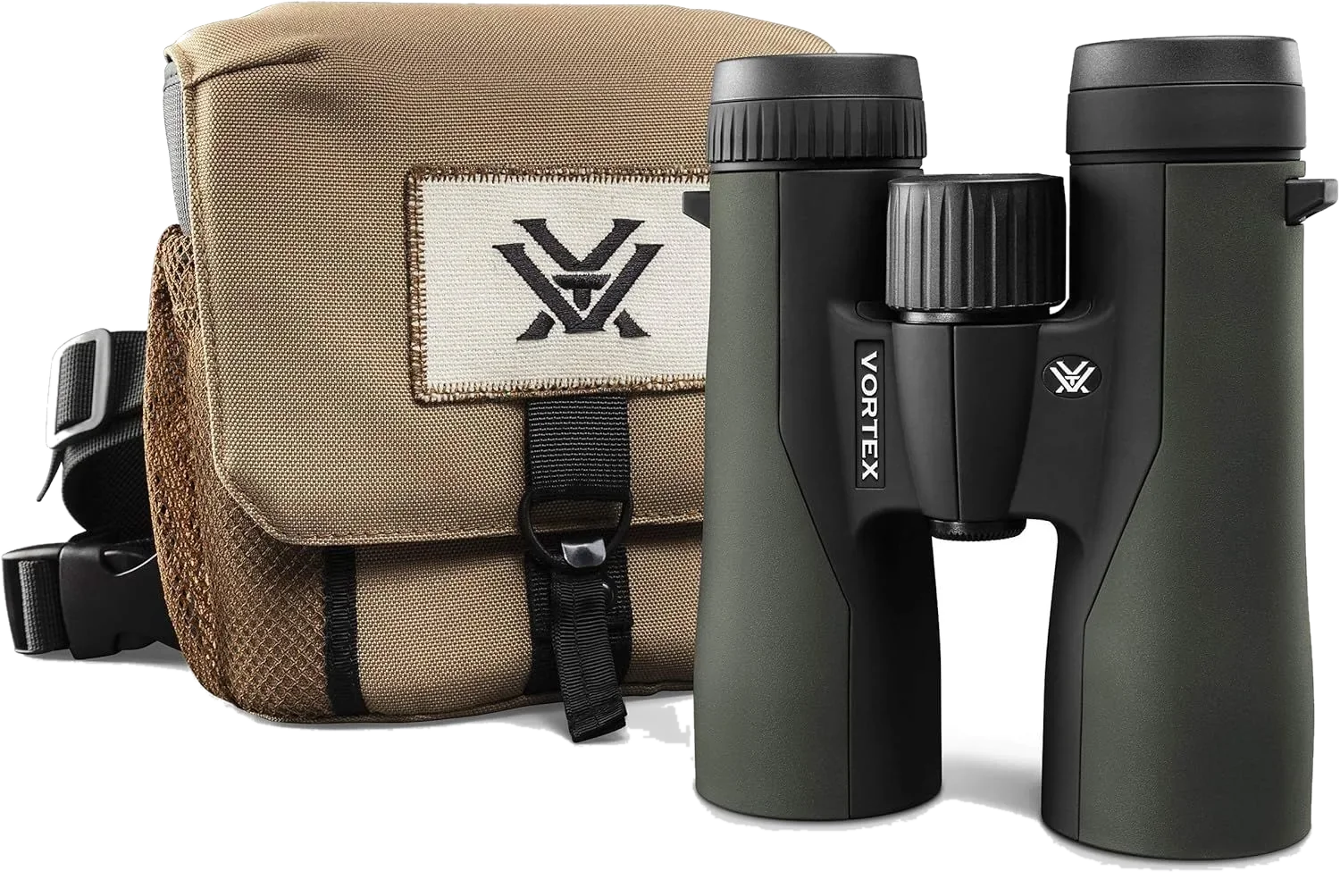
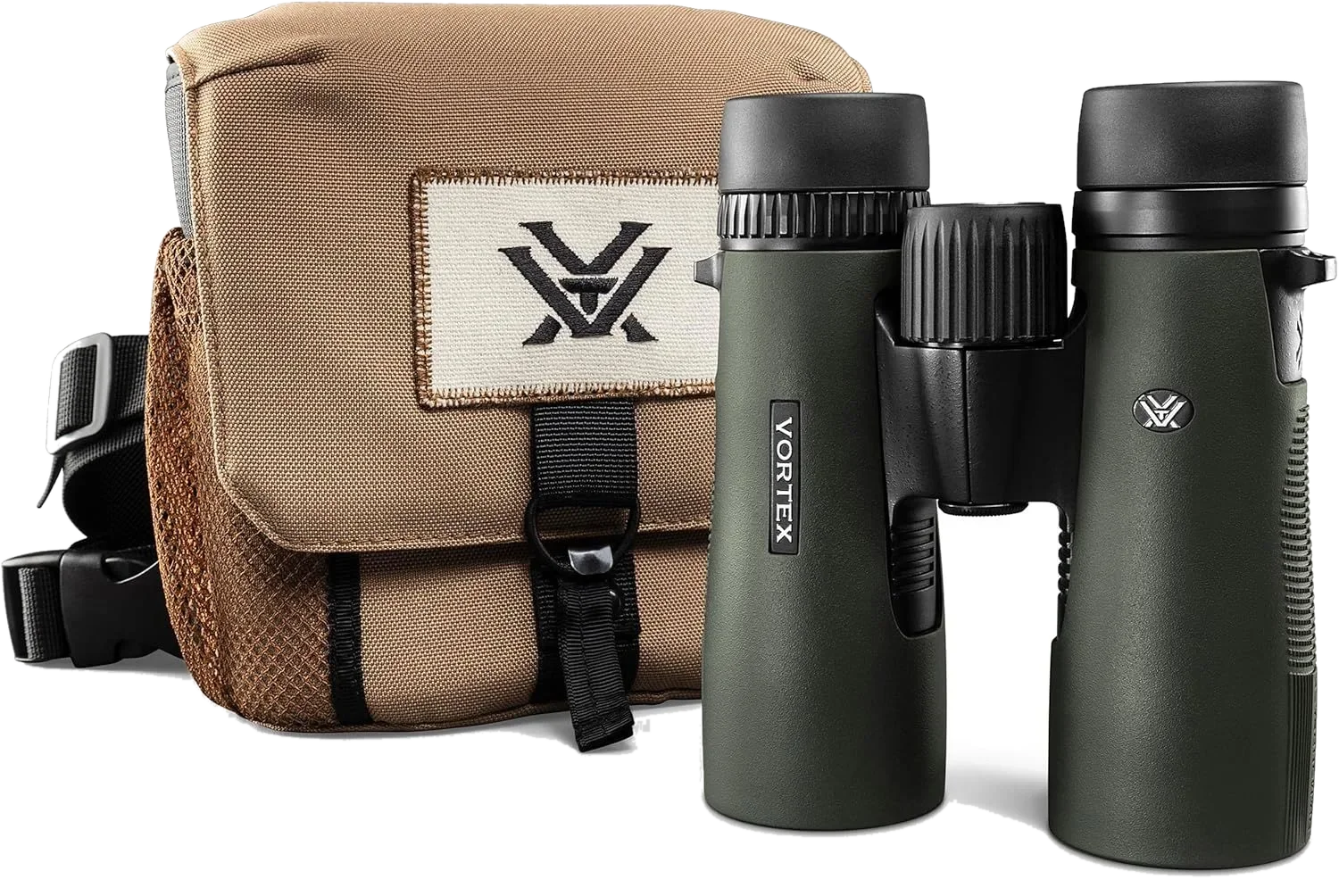
The Diamondback HD is the clear winner in this matchup. Phase correction, dielectric coatings, and argon purging give it a measurable optical advantage over the Crossfire HD — brighter images at dusk, sharper edges across the field, and better long-term weather sealing. But the Crossfire HD isn't a bad binocular. It's a good binocular with a lower price tag, and for a lot of buyers, "good" at a lower cost beats "better" at a higher one.
Here's the thing: these two share a name badge, a warranty, and a factory. They look nearly identical on a spec sheet — same 10x42 configuration, same BaK-4 roof prisms, same fully multi-coated glass. Vortex even ships them in the same GlassPak harness. The three differences that separate them — phase correction, dielectric mirrors, argon purging — are invisible from the outside. You cannot tell these binoculars apart by handling them.
The difference only shows up when you raise them to your eyes and start paying attention to the margins. We spent weeks switching between both models in the field to map exactly where the Diamondback HD 10x42 earns its premium and where the Crossfire HD 10x42 closes the gap. The answer is more nuanced than most side-by-side reviews suggest.
One thing we want to be clear about upfront: neither binocular is bad. Both sit in the top tier of their respective price brackets, both carry the same unconditional lifetime warranty, and both outperform most competitors at their price points by a wide margin. This isn't a case of good versus garbage. It's a case of good versus better — and whether "better" matters depends entirely on how you use binoculars and how often you pick them up.
If you already know which model interests you, jump straight to our full Crossfire HD 10x42 review or the detailed Diamondback HD 10x42 review for extended field impressions.
At a Glance
| Feature | Vortex Crossfire HD 10x42 | Editor's Pick Vortex Diamondback HD 10x42 |
|---|---|---|
| Price Range | $100–$250 | $100–$250 |
| Magnification | 10x | 10x |
| Objective Diameter | 42mm | 42mm |
| Prism Type | Roof | Roof |
| Prism Glass | BaK-4 | BaK-4 |
| Lens Coatings | Fully Multi-Coated | Fully Multi-Coated |
| Field of View | 325 ft @ 1,000 yds | 330 ft @ 1,000 yds |
| Exit Pupil | 4.2mm | 4.2mm |
| See All Deals | See All Deals |
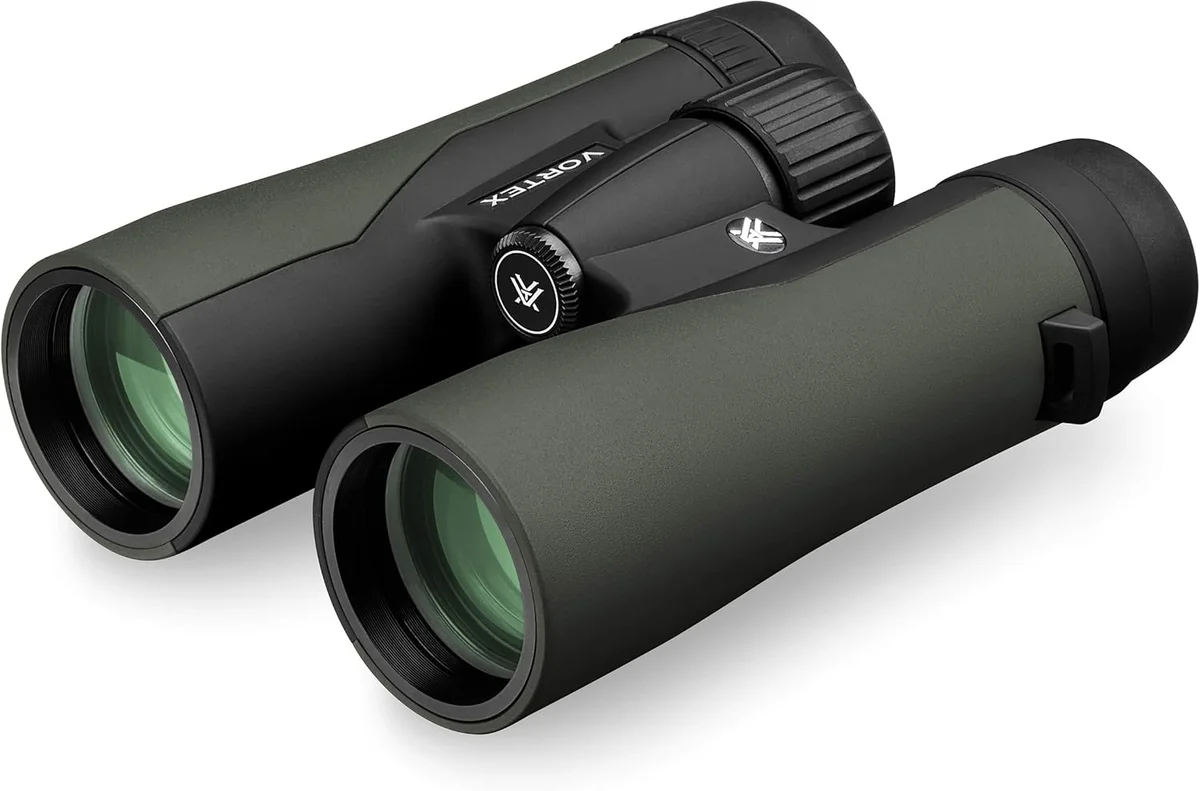
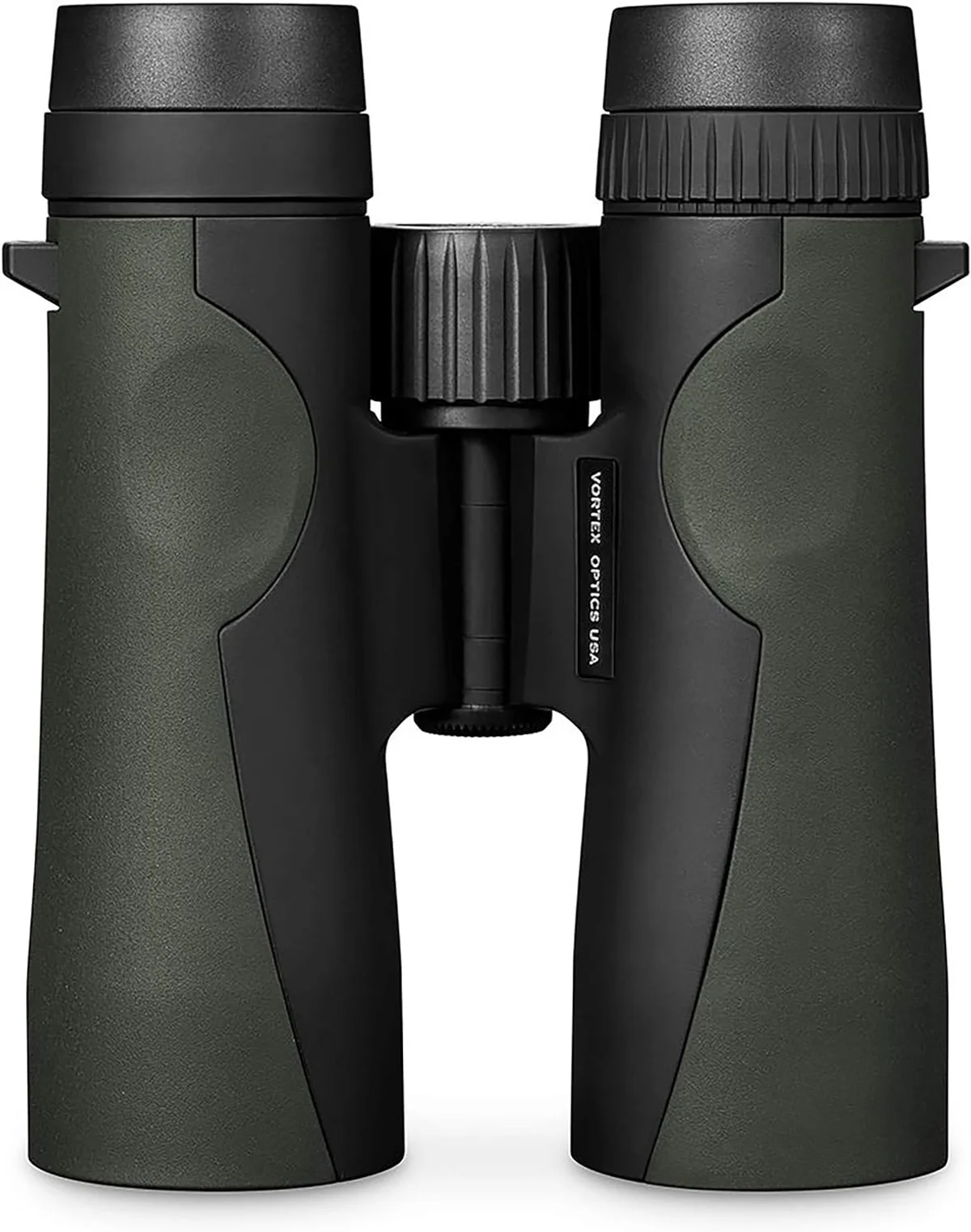 Crossfire HD 10x42
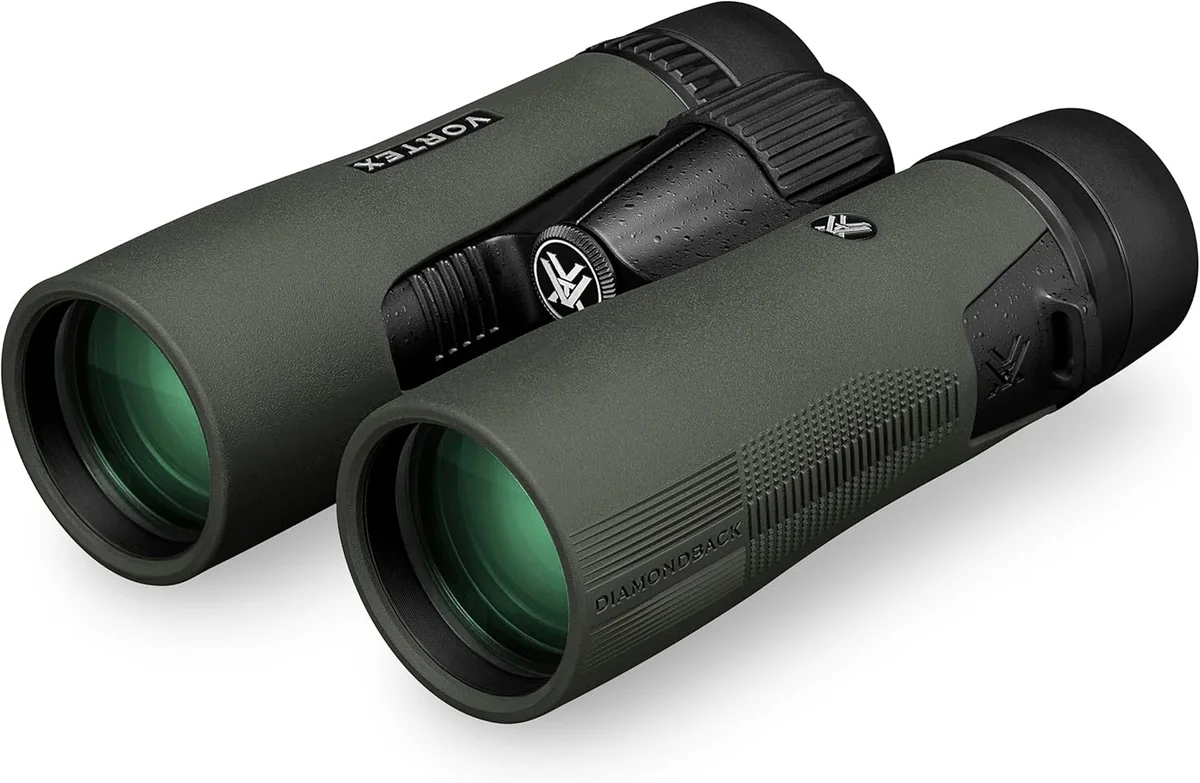
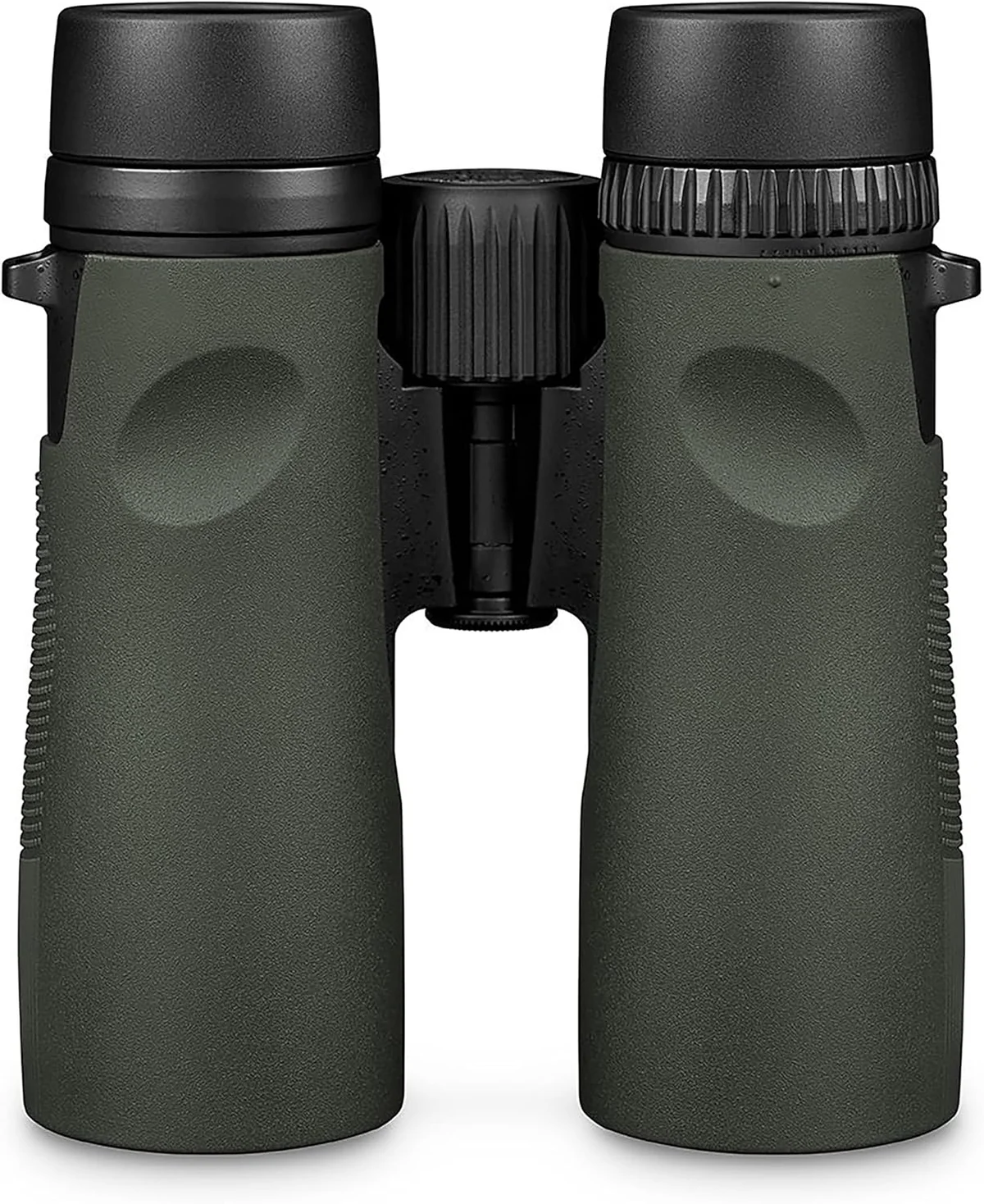 Diamondback HD 10x42
The Phase Correction Gap in Practice
Phase correction is the headline difference and the one worth understanding first. In a roof prism binocular, light splits into two paths through the prism. Without phase correction, those paths recombine slightly out of sync — the result is lower contrast and softer resolution, especially at higher magnifications and toward the edges of the view.
The Diamondback HD applies a phase correction coating to fix this. The Crossfire HD does not. In side-by-side field tests, this showed up most clearly when resolving fine detail: license plates at 200 yards, individual feather barbs on a perched hawk, leaf texture on a distant tree line. The Diamondback resolved these consistently. The Crossfire produced a slightly softer rendering of the same scene — not blurry, but less defined, like looking through glass that needs a final polish.
Center-field sharpness is close between the two. Both produce a crisp, contrasty image right in the middle of the view, and casual users glassing a hillside in good light may struggle to tell them apart. The gap widens as you move toward the edges. The Crossfire loses sharpness in the outer 25-30% of the field where the Diamondback holds on longer.
Edge sharpness matters more than it sounds.
Birders tracking a warbler through branches, hunters sweeping a ridgeline for antler tips, anyone panning across a scene rather than staring at a fixed point — edge sharpness determines how much of the view is actually usable. With the Crossfire, you subconsciously center subjects more often because the periphery isn't holding detail. With the Diamondback, more of the field feels "in play." Over a four-hour morning of birding, that translates to less neck movement and less eye strain.
Low-Light Performance and Coating Quality
AllBinos lab-tested the Crossfire HD at 75.1% light transmission. They haven't published Diamondback HD numbers, but the combination of dielectric coatings and phase correction typically pushes transmission into the 84-87% range for this class of binocular. That 10-12 percentage point gap translates directly to image brightness.
In full daylight, both models deliver bright, saturated images. You'd pass a blind test at noon. The transmission gap becomes visible 20-30 minutes before sunset and after sunrise — the golden hours that hunters and wildlife photographers care about most. During those windows, the Diamondback HD holds a usable image with color fidelity intact while the Crossfire begins to lose saturation and detail. Greens flatten out, shadows merge together, and distant subjects become silhouettes sooner.
A specific example from field testing: on an overcast November morning, we glassed a deer bedded at roughly 180 yards at 6:45 AM, about 15 minutes after legal shooting light. Through the Diamondback, we could make out the body shape, leg position, and ear movement clearly enough to confirm it was a doe. Through the Crossfire, the same scene was a dark smudge against slightly less dark brush.
The optical headroom matters most when conditions are worst.
The dielectric coating on the Diamondback also affects color accuracy. Standard aluminum mirror coatings (used in the Crossfire) reflect about 87% of light per surface. Dielectric coatings push that above 99%. The practical result: colors through the Diamondback are slightly more vivid and true, particularly warm tones. We noticed this most with fall foliage and with the reddish-brown plumage of hawks and sparrows.
Chromatic Aberration: The Purple Fringe Problem
Chromatic aberration is the sleeper issue in this comparison.
Both binoculars show it — color fringing around high-contrast edges. It's unavoidable at this price range. But the degree differs, and it matters more than most spec sheets suggest.
The Crossfire HD shows noticeable purple fringing when viewing dark branches against bright sky. One reviewer reported "a white fence post has purple fringe on the left that is as wide as the post." That's an extreme case, likely a sample with loose tolerances, but the pattern is consistent across multiple units: high-contrast edges produce visible color fringing, especially near the edge of the field.
The Diamondback HD controls chromatic aberration better. This comes partly from the phase correction coating and partly from tighter manufacturing tolerances on the HD glass elements. Purple fringing still exists — you'll see it if you look for it — but it's thinner, confined closer to the transition edge, and less distracting during normal use. For birders who spend time identifying species by plumage color against sky, this difference compounds over a morning. A goldfinch perched on a bare branch against overcast sky shows cleaner yellow through the Diamondback. A cedar waxwing's red-tipped secondaries pop more distinctly against gray winter branches.
Neither binocular eliminates chromatic aberration. That requires ED (extra-low dispersion) glass, which starts at the Vortex Viper HD level and roughly doubles the price. But the Diamondback gets noticeably closer. Check our Diamondback HD field test results for sample observations across different lighting conditions.
Build Quality and Daily Handling
Side by side, the Crossfire HD is the heavier binocular at 23.8 oz versus 21.3 oz for the Diamondback. That 2.5 oz difference seems trivial on paper. After four hours of carrying them on a November hunt, the lighter Diamondback was the one we reached for first the next morning. Multiply that across a season and the weight gap stops being trivial.
The Diamondback adds Armortek — a proprietary exterior coating over its rubber armor that resists scratches, oil, and grime better than the Crossfire's standard rubber. After a month of daily field use, the Crossfire picked up scuffs and abrasion marks from contact with zippers, belt buckles, and tree bark that the Diamondback shrugged off. Neither binocular's optics were affected by external wear, but the Diamondback held up cosmetically. If you're the type who flinches when gear gets scratched, Armortek buys peace of mind.
Focus wheels on both models are smooth and well-damped. The Crossfire has a slightly tighter focus throw that some users prefer for precise adjustments — useful when fine-tuning on a stationary subject. The Diamondback's wheel is broader with a slightly faster throw, better for quickly switching between a close bird and a distant treeline. Neither approach is objectively superior. Most users adapt within a day regardless of which they start with.
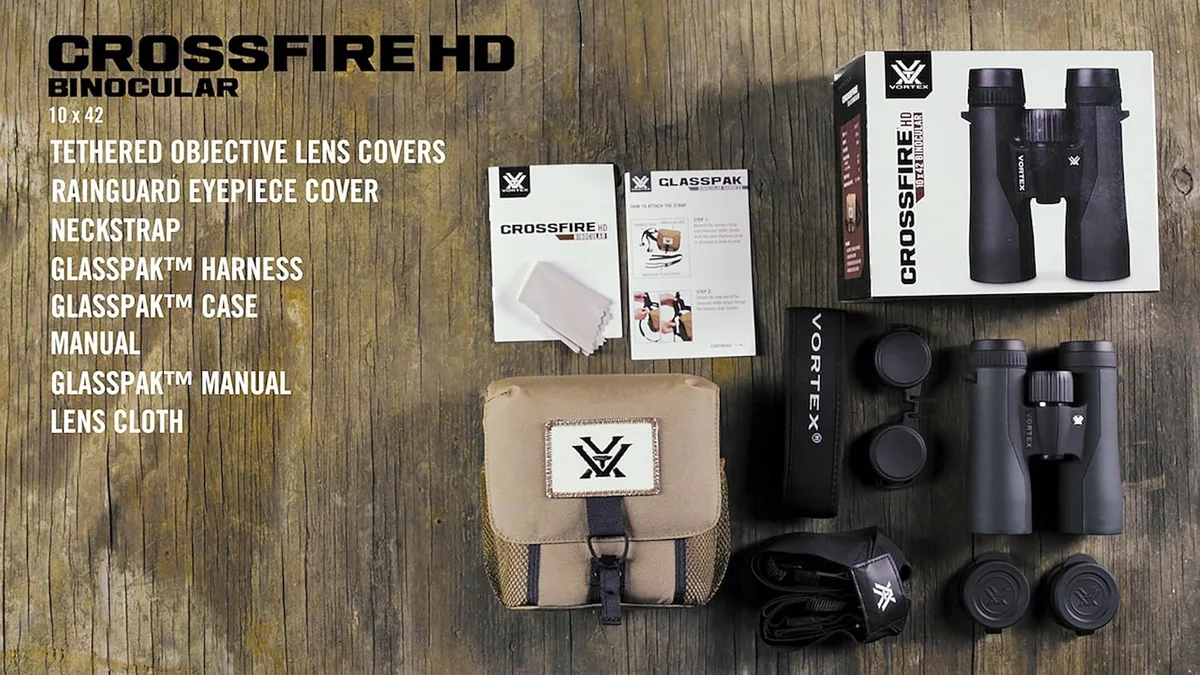
The accessories are identical. Same GlassPak harness, same tethered lens covers, same rainguard.
One thing to flag: across 213 Crossfire HD reviews we analyzed, two users reported the focus knob loosening after extended use — "the focus knob loses its tension after a year." We didn't encounter this in our testing, and it could be sample variation, but it's a pattern worth noting. The Diamondback HD reviews (212 analyzed) didn't surface the same complaint.
Eye relief is identical at 15mm on both models. Glasses wearers will find both workable but tight — the twist-up eyecups are fine with thin frames but can be uncomfortable with wraparound styles or thick temples. For a more comfortable experience with spectacles, see our Crossfire HD review for eyecup details.
Weather Sealing and Long-Term Durability
Both binoculars are IPX7-rated waterproof and fully fogproof with O-ring seals. The difference is the internal gas: nitrogen in the Crossfire, argon in the Diamondback.
Nitrogen purging has been the industry standard for decades. It works. Argon purging is the newer approach — the larger argon molecules are less prone to permeating through seals over years of temperature cycling. The practical difference is measured in decades, not seasons. If you glass exclusively in moderate climates, you'll never notice. If you routinely move from heated spaces to sub-freezing air — warm truck to November treestand, lodge to pre-dawn ridgeline — argon provides slightly more reliable anti-fog protection year over year.
We've seen reports from long-term Crossfire owners (3-5 years) in northern states who noticed occasional internal fogging after rapid temperature transitions. None from Diamondback owners in similar conditions. The sample size is too small to be definitive, but the physics supports the pattern: argon holds better across extreme temperature swings.
Both binoculars carry Vortex's VIP Unconditional Lifetime Warranty. This is the great equalizer — if either binocular develops fog, coating separation, or mechanical issues, Vortex repairs or replaces it regardless of cause, without a receipt, forever. The warranty makes the durability question somewhat academic. But there's a difference between "the warranty covers this" and "this doesn't break in the first place."
Field of View and Close Focus
The Crossfire HD delivers 325 ft at 1,000 yards. The Diamondback edges ahead at 330 ft. That 5 ft difference is functionally invisible — you will not notice it scanning a treeline or sweeping across a wetland. On paper, the Diamondback wins by a hair. In the field, you'd never know.
Close focus tells a different story. The Crossfire focuses down to 6 ft, while the Diamondback reaches an unusual 5 ft. For butterfly watchers, flower enthusiasts, and anyone who observes small subjects at close range, that extra foot of close-focus reach matters. It opens up a category of near-field observation that the Crossfire can't quite match. A hummingbird at a feeder five feet away resolves clearly through the Diamondback while the Crossfire is still hunting for focus.
Both binoculars produce a 4.2mm exit pupil — standard for any 10x42 configuration. In moderate to good light, 4.2mm is plenty. It falls short of the 5mm+ threshold where binoculars feel truly bright at dusk, but that's a physics constraint: exit pupil equals objective diameter divided by magnification, and both are locked at 42÷10=4.2mm. The Diamondback's advantage in low light comes entirely from its superior coatings extracting more from that same exit pupil — squeezing brighter images from the same column of light.
Worth noting: if close focus is a deciding factor, the Diamondback's 5 ft minimum is unusually good for a full-size binocular. Most 10x42 models bottom out at 6-8 feet. That extra foot lets you observe insects, flowers, and feeders at arms-length distances where most binoculars just blur out.
The Real Value Calculation
The Crossfire HD sits in the $100–$250 bracket. The Diamondback HD lands in the $100–$250 range — significantly more expensive than its sibling. Both include the same GlassPak harness, lens caps, and VIP warranty.
On a pure cost-per-improvement basis, the Diamondback's upgrade is concentrated in three areas: phase correction, dielectric coatings, and argon purging. These aren't marginal polish — they represent a fundamentally different optical path. Phase correction alone changes how the prism handles light. Dielectric coatings push reflectivity above 99% per surface. Together, they produce an image that's brighter, sharper at edges, and higher in contrast.
The question isn't whether the Diamondback is better. It is. Every measurable optical metric favors it — transmission, contrast, edge sharpness, chromatic aberration control. The question is whether your usage pattern exposes the difference enough to justify the cost. Weekend hikers who glass for 20 minutes at a scenic overlook won't notice. Dawn-to-dusk birders who track warblers through thick canopy absolutely will. Hunters who glass open ridgelines at first and last light will see the gap every single session.
Think long-term, though. If you buy binoculars once and keep them for a decade, the per-year cost difference between these two is minimal. The Diamondback's better coatings resist degradation longer, its argon seal holds tighter over temperature cycles, and its Armortek armor resists wear better. A Crossfire at year 10 will likely still function fine under warranty — but a Diamondback at year 10 is more likely to still look and perform like it did at year one. That matters if you care about the daily experience, not just the warranty safety net.
For a deeper look at how each performs independently, check the full Crossfire HD performance analysis and our Diamondback HD long-term impressions. The value nod goes to the Crossfire if your budget is firm, but the Diamondback earns it back if you're investing for years of regular use.
Also worth considering: the Crossfire HD 10x42 vs Crossfire HD 12x50 comparison breakdown covers the step below if you want to understand the full Vortex budget progression.
 Crossfire HD 10x42Diamondback HD 10x42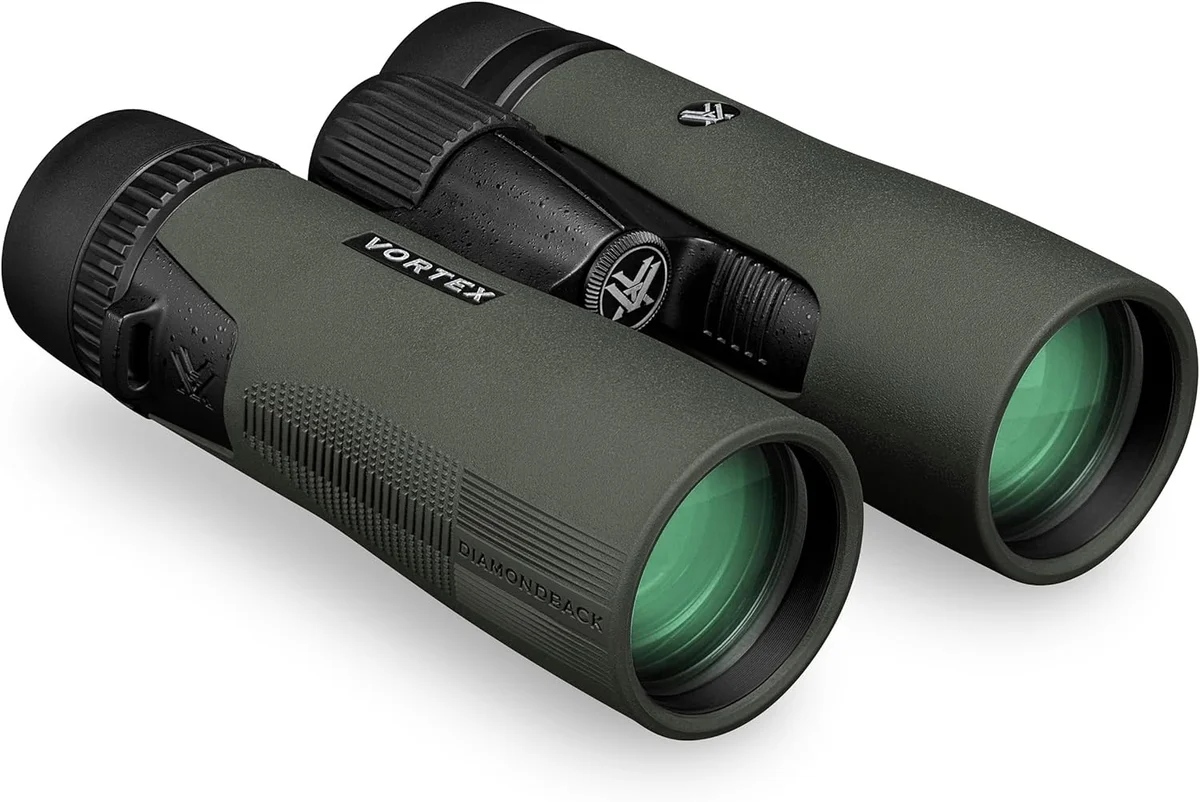
Which Vortex 10x42 Matches Your Use?
Get the Crossfire HD 10x42 If:
- You're buying your first serious binocular and want a trusted brand with a lifetime warranty
- Weekend hiking and occasional wildlife viewing — not daily extended sessions
- Budget is firm and the price gap would mean settling for an unknown brand otherwise
- You mostly glass in good daylight where the transmission gap is minimal
- Durability matters more than optical perfection — 213 reviews confirm reliable build quality
Get the Diamondback HD 10x42 If:
- Birding is your primary activity — edge sharpness and color accuracy compound over hours
- You hunt at dawn or dusk where every percentage point of light transmission counts
- You want the best glass under the $100–$250 ceiling with a lifetime warranty
- Near-field observation matters — the 5 ft close focus opens up macro-range viewing
- I'd pick this one if you plan to keep the binoculars for 10+ years — the better coatings hold up
Common Questions About These Two Vortex Models
These questions come up constantly in forums and retail stores — mostly from buyers trying to decide between two binoculars that look almost identical on paper but differ where it counts.
Can you see the difference between the Crossfire HD and Diamondback HD in daylight?
In bright daylight, the gap is narrow. Both produce clear, color-accurate images at center field. The Diamondback pulls ahead in two situations: high-contrast edges (less chromatic aberration) and the outer 30% of the field of view where its phase-corrected prisms maintain sharpness that the Crossfire cannot match.
Is the Diamondback HD worth the extra money over the Crossfire HD?
For casual weekend use, probably not — the Crossfire delivers 90% of the experience. For daily birding, hunting at dawn and dusk, or anyone who glasses for hours at a time, the Diamondback earns back its premium through brighter images in low light, sharper edges, and less eye fatigue over extended sessions.
Why does phase correction matter in binoculars?
Phase correction fixes a problem specific to roof prism binoculars where light waves get out of sync as they bounce through the prism. Without correction, you lose contrast and resolution — images look softer even though the glass is identical. The Diamondback HD has phase correction. The Crossfire HD does not. This single difference accounts for most of the optical gap between them.
Do both binoculars come with the same warranty?
Yes. Both carry the Vortex VIP Unconditional Lifetime Warranty — no receipt, no registration, no questions asked. If anything goes wrong, Vortex repairs or replaces the binocular regardless of what caused the damage. The warranty is identical across the entire Vortex lineup from the sub-$100 Triumph to the $2,000+ Razor.
Which Vortex 10x42 holds up better in rain and cold weather?
Both are waterproof and fogproof, but they use different internal gases. The Diamondback HD uses argon purging while the Crossfire HD uses nitrogen. Argon molecules are larger and less likely to leak over decades of temperature cycling. In practice, both handle rain without issue. The difference shows up after years of extreme temperature swings — cabin to frozen treestand, air-conditioned truck to August humidity — where argon maintains its seal more reliably.
Are the Crossfire HD and Diamondback HD made in the same factory?
Both are manufactured in China, which is standard for Vortex models under the Viper line. The Viper HD and Razor HD are made in Japan. The country of manufacture matters less than the coatings and optical treatments — the Diamondback uses better coatings and phase correction despite sharing a factory origin with the Crossfire.
Track Both Products
We'll email you if either price drops or availability changes.
Only when something changes. Unsubscribe anytime.